Part 2 Bygone Days in the Ritz Caféy Lifford
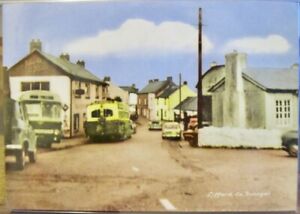 image credit internet
The following Thursday The bell above the cafey door pinged
There stood Fran, good as his word, ready to help my mother with the pre-cooking of the fish. The cafey had a new fish fryer. Pulling off his cream jacket, he pulled on his grey work coat; flipped up the lids of the two-pan deep fat fryer Daddy and mammy had went to the bottom of Ireland to buy.
Apparently, my father, Tommy, had planned on buying a single chip pan but Wee Madge, our mother, spoke up when the dealing was being done between the men and declared the chip pan was ‘Far too wee’ and in the end the double fish and chip pan was bought. She always was one for getting the last word.
I remember them bringing it home. We probably thought it was like something out of Doc Who. It stood on four squat feet with two deep pans with lids that clattered down and with two smaller rectangle sections at the top with lids that opened up like eyelids. It gleamed silver under the lights and had a kind of a ‘wicked’ or magical feeling about it as it stood in the middle of the back kitchen in the cafey, the locals crowding around to admire it.
It didn’t bother the new fish fryer. It was all in a day’s work for him. He had seen it all before in his job in Cassoni’s in the Back Street in Strabane. He tucked a tea-towel into the belt of his jeans and tested to see if the fat was warm enough to half cook the fish, delivered fresh from Killybegs Fisheries that morning.
My mother had a way of preparing the fish; first the huge slabs of frozen fish that looked like small icebergs would be let defrost, then she’d separate the individual fish from their icy bed, lay them out on big flat trays before dipping each piece in dry batter (flour.
Then it was the fish fryers turn. With the boiling fat gurgling and spitting and swelling like the rising tide around the rim of the pan he dipped the fish in wet batter and precooked it to a light golden brown ready for it to be freshly cooked when a customer like big Jim Mc Dougall came in and gave his order.
Big Jim was a real gentleman. For years we’d passed by his family farm on our way home from Murlog National School. He’d come in to the cafey, shake the rain or the snow of his shoulders, unbutton his overcoat, sit himself down in his usual chair, take off his trilby type hat with the dimple in the side, hang it on his knee and say,” “A wee trout, if you please.”
My mother always attended to Jim herself. She’d come out from behind the counter and spend a minute or two talking to him. Then, instead of giving in the order to Fran or whoever was frying the fish that night, she’d go personally into the kitchen and ensure Big Jim got two large choice pieces of Killybegs catch.
Lifford was a booming market town. It got a lot of cross border trade. Drink and cigarettes were cheaper in the south of Ireland than in the North
Different nights brought different customers to the town and the cafey. On a Friday night you’d get the regulars; older men and family men, who came in for a few drinks to Harte’s or the Central bar. It was their night out at the end of a working week. These were mostly farmers, labouring men and skilled tradesmen – joiners and fitters who worked at Doherty’s Coffin Makers down the Diamond.
Saturday night brought a bigger crowd. When the pubs came out at 11.30 at night, (yes, the pubs closed early) the café would fill to overflowing with men buoyed up by the beer, hungry for fish suppers and sausage suppers. The crowds kept coming until well after midnight; the place would be mobbed. As the tables, lined up and down the floor emptied they were immediately filled again. Above the chatter of talking and the clatter of crockery and cutlery the jukebox played.
Getting through the crowd with customers’ orders was tricky. The smell of the passing food was too much for some people and they’d stretch out and help themselves to a handful of chips from another customer’s plate. Sometimes the customer took it in a good humoured way and sometimes it started a war of words between them customers
. A chorus of “F…k! We’re trying to get served here.” would resound from other male customers. Some, like big Tommy Howard (RIP) were on their way to work as ‘Bouncers’ in the newly opened Mecca – Later the Orchid ballroom near the old Lifford Railway Station (favourite place for the courting couples, including Fran and me)
You didn’t ‘turn the word’ on the bouncers (security staff). Or, you likely find yourself ‘barred’ from the ‘ballroom of romance’ where the big pop stars like Jim Reeves,, Charlie Pride and the best Irish Showbands were playing.
Other customers hemmed in in the middle of the floor that couldn’t get near the counter to place their order tried to catch the waitresses’ eye in the hope of getting served quicker. And sometimes it worked if the waitress fancied a night at the pictures with them.
Too hungry to wait for a table, other customers lined up two abreast for takeaways; unwrapping their fish and chips from the brown wrapping, they’d spilled out into the street and find a seat on a window ledge to sit on to eat their fish and chips.
Business was booming. Extra waitresses were needed and I remember my ‘cousins’ Anne Gallen and Edwina Devenney (our father’s cousins) and Annette Mc Glynn from Ballindrait and Geraldine Carlin from Lifford working there. Charlie Lafferty (RIP), who worked for our father and who was part of our lives as we grew up helped out in pre-cooking.
Despite the pressure of running two businesses and looking after a growing family my mother Madge loved it. She loved the crowds of fishermen, farmers and young people who filled the café on a Friday and Saturday night. She loved dealing with the men from Killybegs Fisheries who delivered the fish in blocks of ice. It was no bother to her.
Most weekend nights it was a mix of fishermen from Porthall and St Johnston, and customers from Strabane.
Fishing was a thriving industry. The season officially opened in April and closed in August. And in-between times the poachers kept the Water Bailiff’ busy as they fished illegally without licences.
A good catch of salmon brought good money which the hard working young fishermen weren’t afraid to spend. They were out for a good time. They pumped a continuous stream of sixpences and shillings into the jukebox adding to the general happy melee of joking, back slapping and good natured shoving and pushing.
There was a steady footfall of people walking and driving the two miles from Strabane across Lifford’s old stone bridge to get their cigarette supply for the coming week. And while they were there they’d do a bit of window shopping and maybe put a deposit down on a nice watch in Lizzy Thompsons as a present for the wife or girlfriend for a birthday or for Christmas. Or, buy a wee Irish souvenir in Eamon Martins Gift Shop to send to family in England. Hughie Mc Graine was a great place for getting a stock of rock or Peggy’s leg to take home to the weans (children).From there they’d make their way to Roddy Doherty’s in the main Street and ‘slip in’ Harte’s Bar on the corner for ‘quick’ few drinks. They woman slipped into the wee ‘snug’ and divil a word was said about it.
Coming along Bridge Street and around Devine’s Corner, a cacophony of sounds floated out the open pub windows; the clink of glasses, the hum of voices (mostly men’s) rose and fell; the sound of somebody playing an accordion or the strains of a guitar; singing, as somebody burst into an impromptu version of “Danny Boy”. And others called out ‘Best of order now for the singer.”
Other nights, especially if a good band was playing in the Mecca ballroom it would be a younger, drinking, dancing crowd. Romances flourished over a plate of chips and two straws in a glass of Mc David’s lemonade. Or, the romance would crash and die if a partner was found to be ‘two-timing’ (cheating) on them with somebody else.
On these nights my father was always about the café. Fights could break out as drink made the wounded party brave enough to tackle the new boyfriend of his old flame. Or, old scores would be settled between the Strabane boys and the Lifford boys who would ‘gang’ up on each other.
Regardless of which townland or village they came from the Lifford boys and the lads from the country areas would band together when it came to fighting the ‘Townies’. The shout would go up.” Beat them fuc…ers back over Lifford Bridge into Strabane. “
In those days the Garda (Irish police) were both feared and respected. The sight of a broad shouldered uniformed Garda walking past the caféy door or standing across the street, baton in full view was enough to quieten the most belligerent lovelorn youth.
Many a night folklore helped the Guards to keep order. In times past, Lifford had had a courthouse situated in the Diamond opposite the County House with a jail in the dungeons. Stories abounded of hauntings and hangings. The story of half-hung Mc Naughton resonated down through the generations. It was all in the past. But the stories of the treatment of prisoners had passed into folklore. Nobody wanted to take the chance and end their Saturday night in the Garda cells.
And so, about 2am the street outside the cafey would finally quieten. My father would lock the door on the last customer of the night, gather family and staff into our minibus turn out the cafey lights turn the key in the door and head for home.
Gemma Hill 2021©
 Gemma Hill Writeyou Writeme